

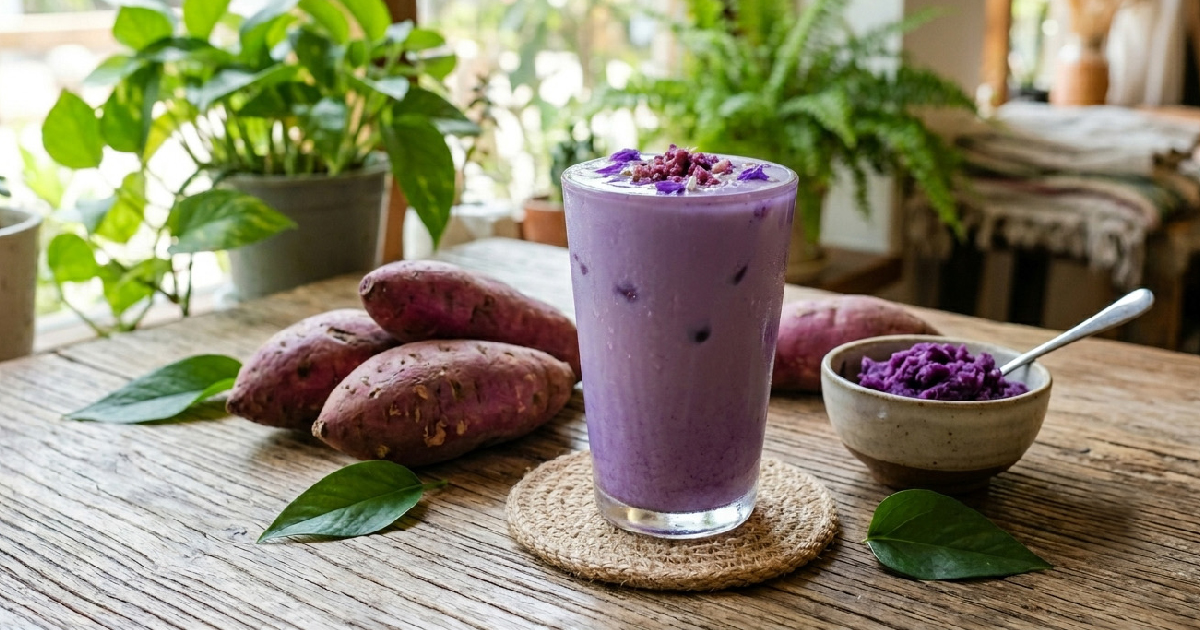
The most striking feature of Ube Latte is its deep, bluish-purple hue. When seeing it for the first time, many consumers' immediate reaction is, "There must be artificial coloring in this." In reality, this vibrant color comes entirely from the purple sweet potato itself, and the chemical mechanism behind it is far more fascinating than any artificial dye.
Anthocyanin: A Color-Shifting Pigment
The secret behind the Ube's color is anthocyanin, a natural pigment widely found in dark-colored fruits and vegetables like blueberries, purple cabbage, and red dragon fruit. Anthocyanin possesses a unique chemical property: its color changes depending on the pH level (acidity or alkalinity) of its environment.
- In acidic environments (low pH): Anthocyanin shifts toward reddish tones.
- In neutral to weakly alkaline environments: It turns into a bluish-purple or deep purple hue.
This explains why blueberry jam (which is acidic) appears reddish-purple, while our purple sweet potato milk tea—situated in the neutral environment of milk tea—displays a rich, saturated deep bluish-purple. This is not the work of additives; it is simply the anthocyanin's faithful chemical response to its environment.
Why Does Anthocyanin Easily "Fade"?
While anthocyanin is natural, it is also a relatively fragile pigment. High temperatures, prolonged heating, and exposure to intense light can accelerate its oxidation and degradation, causing the color to fade or even turn brown.
Because of this, during the brewing process of our Ube Latte, we utilize a low-temperature simmering extraction method and shorten the heating time. This allows us to extract the natural sweetness and flavor of the purple sweet potato while preserving the maximum amount of anthocyanin. This is also why the color intensity may vary slightly from batch to batch—because it is made from real ingredients, not a fixed artificial dye formula.
Where Does the Mouthfeel of Purple Sweet Potato Come From?
Beyond its color, the Ube contributes a distinct starchy texture to the beverage. Rich in complex carbohydrates, the Ube releases a natural thickness when simmered, giving the Latte a richer, smoother, and slightly pureed texture. This texture differs from the "chewiness" of traditional boba; it feels as though the drink itself has weight, creating a more pronounced presence on the palate.
The inherent sweetness of Ube is more subtle and less caramelized than that of regular yellow sweet potatoes. When paired with Latte, it avoids overwhelming sweetness. Instead, the creamy milk and earthy potato flavors blend naturally, creating a satisfying, filling drink with a long-lasting aftertaste.
A Drink with "Honest" Color
We cannot guarantee that every single cup of Ube Latte will look exactly the same shade of purple, because that is the nature of real ingredients. However, we can guarantee that this color comes entirely from the raw ingredient itself, not from a bottle of artificial dye. For those who love purple sweet potato, you can taste it; for those curious about anthocyanin, this drink is a science experiment you can taste.