

Matcha isn't just "green tea powder" — it's a precise chemical system. With the exact same matcha, changing the water temperature, the powder-to-water ratio, or the whisking technique can shift the flavor from sweet and mellow to bitter and harsh. This article first breaks down the science behind matcha's flavor, then gives you five recipes with exact gram measurements and ratios so you can reproduce consistent results at home.
1. The Chemistry Behind Matcha's Flavor
Matcha's taste is mainly determined by three groups of compounds:
| Compound | Main Flavor | Extraction Behavior |
|---|---|---|
| Catechins (mainly EGCG) | Bitter, astringent | Extract more readily at high temperature |
| Caffeine | Bitter, stimulating | Extracts more readily at high temperature |
| L-theanine and other amino acids | Sweet, mellow (umami) | Extract well even at low temperature; largely fully extracted by 60–70°C |
Amino acids are largely fully extracted once water reaches 60–70°C, and extracting at higher temperatures makes little additional difference; caffeine and catechins, on the other hand, need higher temperatures to be released in full. This is why water temperature is the single biggest variable in how good your matcha tastes: the hotter the water, the more bitter catechins and caffeine get pulled out along with everything else, overpowering the sweetness of the amino acids.
Experimental data backs this up: matcha's total phenolic content and antioxidant activity peak when prepared at around 80°C with a 20-minute extraction, and finer particle size also improves the extraction of phenolic compounds. Tea extracted at 80°C also showed higher levels of phenolics, flavonoids, and vitamin C compared to tea extracted at 90–96°C. In other words, around 80°C is the sweet spot for flavor compounds and antioxidants — push the temperature higher and what you extract more of is mostly bitterness, not the good stuff.
Boiling water is also not recommended for matcha: the higher the water temperature, the more pronounced the aroma and the easier it is to whisk up foam — but water that's too hot also releases more of the astringent, bitter catechins and caffeine, ultimately producing a bitter, harsh bowl of matcha. The industry standard is to whisk with water at 70–80°C and drink it once it cools to 60–70°C.
Practical takeaways:
- For a sweet, mellow flavor → use 70–75°C water, or even a cold brew
- For more aroma with a slightly bitter, lingering finish → go up to around 80°C
- Avoid boiling water (100°C) — it damages the amino acids and pulls out excessive bitterness
2. Base Recipe #1: Usucha (Thin Tea)
This is the "mother recipe" for every matcha drink. Once you've nailed this ratio, the latte and the smoothie below are just variations on it.
Ratio: matcha : hot water = 1 : 30 (by weight)
| Ingredient | Amount |
|---|---|
| Matcha powder | 2 g |
| Hot water (75–80°C) | 60 mL |
Method:
- Sift the matcha powder first to break up clumps — finer particles extract phenolic compounds more efficiently.
- Pour the hot water into a bowl and add the matcha powder.
- Whisk briskly in a "W" motion with a chasen (bamboo whisk) for 20–30 seconds, until a fine foam forms on the surface.
- Let it sit for 10 seconds so large bubbles settle, then drink.
3. Recipe #2: Matcha Latte
Ratio: matcha paste (matcha : hot water = 1:10) + 200 mL milk
| Ingredient | Amount |
|---|---|
| Matcha powder | 3 g |
| Hot water (80°C) | 30 mL |
| Milk | 200 mL |
| Honey or syrup (optional) | 10–15 g |
Method:
- Add the matcha powder to 80°C hot water and whisk until smooth and free of lumps, forming a thick paste. Using hot water at this stage helps fully dissolve the powder, since matcha doesn't dissolve well in cold liquid.
- Heat the milk to 60–65°C — staying under this temperature preserves the milk's flavor and avoids over-denaturing the proteins.
- Pour the matcha paste into a cup and slowly add the warm milk.
- Stir in honey or syrup to taste.
4. Recipe #3: Cold Brew Matcha
Because amino acids extract well even at low temperature while catechins and caffeine extract less readily in the cold, cold-brewed matcha comes out sweeter and less bitter than a hot preparation.
Ratio: matcha : cold water = 1 : 50
| Ingredient | Amount |
|---|---|
| Matcha powder | 3 g |
| Cold filtered water (about 4–10°C) | 150 mL |
Method:
- First mix the matcha powder with a small amount of room-temperature water (about 10 mL) into a smooth, lump-free paste, so it doesn't clump when it hits cold water.
- Add the remaining cold water and stir, or whisk gently with a chasen until combined.
- Refrigerate for at least 30 minutes before drinking — this rounds out the flavor.
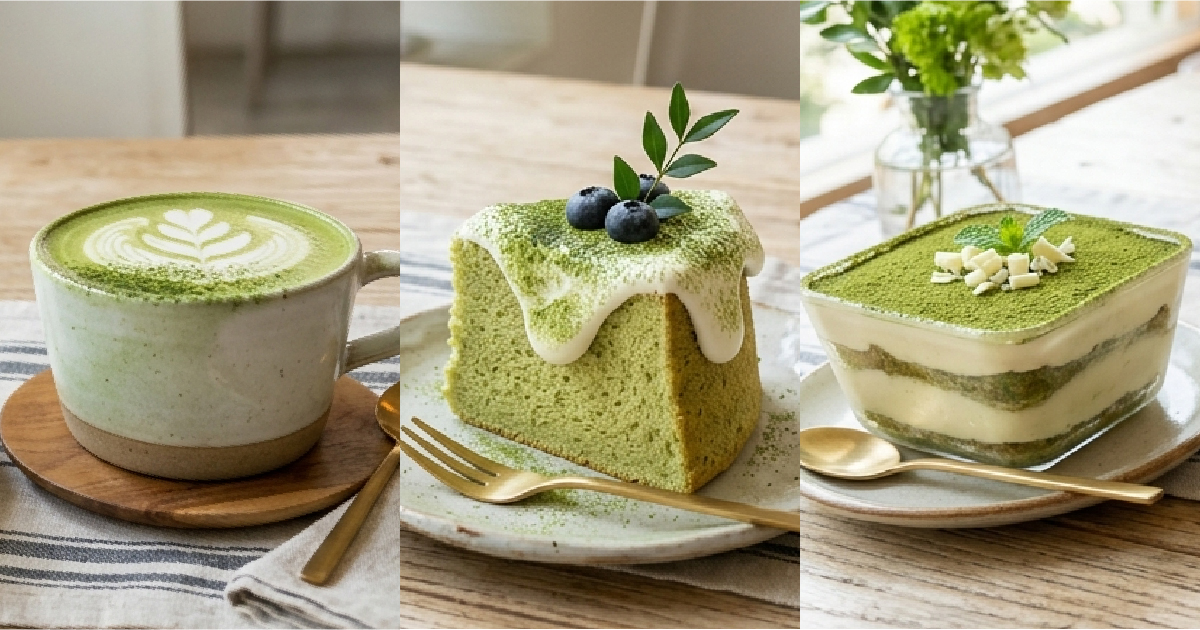
5. Recipe #4: Matcha Chiffon Cake (Baking Ratio)
In baking, matcha is usually measured as a percentage of the flour weight, which makes it easy to scale the recipe up or down for different pan sizes.
Ratio: matcha at 5–8% of flour weight (this recipe uses 6%, suited to a 6-inch pan)
| Ingredient | Amount |
|---|---|
| Cake flour | 60 g |
| Matcha powder | 4 g (about 6.7% of the flour) |
| Egg yolks | 3 |
| Sugar (for yolks) | 20 g |
| Vegetable oil | 30 g |
| Milk | 40 g |
| Egg whites | 3 |
| Sugar (for whites) | 40 g |
Method:
- Sift the matcha powder together with the cake flour twice, to break up clumps and mix the powders evenly.
- Whisk the egg yolks with sugar until pale and slightly thickened. Add the oil, then the milk, mixing after each addition. Sift in the flour mixture and fold in until you have a smooth batter.
- Add sugar to the egg whites in three additions, whipping to a medium-firm peak (the peak should curl slightly when the whisk is lifted).
- Fold one-third of the meringue into the batter to loosen it, then fold that mixture back into the remaining meringue, using a gentle folding motion to avoid deflating it.
- Pour into the pan, tap out large air bubbles, and bake at 150°C for 35–40 minutes.
- Invert the pan immediately after baking and let it cool upside down to prevent the cake from collapsing.
Tip: Matcha tends to oxidize and lose some color under high heat (like baking), so the baked cake will look a shade lighter than the raw batter — this is normal. For a more vibrant green in the finished cake, choose a food-grade matcha with stable color and a properly completed steaming (kill-green) process.
6. Recipe #5: No-Bake Matcha Tiramisu
Ratio: matcha : hot water (for soaking liquid) = 1 : 8
| Ingredient | Amount |
|---|---|
| Ladyfinger biscuits | 12 pieces (about 100 g) |
| Matcha powder (for soaking liquid) | 5 g |
| Hot water (80°C, for soaking liquid) | 40 mL |
| Mascarpone cheese | 250 g |
| Heavy cream | 150 g |
| Sugar | 40 g |
| Egg yolks | 2 |
| Matcha powder (for dusting) | as needed |
Method:
- Whisk the matcha powder with the hot water until smooth to make the soaking liquid, then let it cool — this is what you'll dip the ladyfingers in.
- Whisk the egg yolks with half the sugar over a double boiler until thick and pale, then fold in the mascarpone until smooth.
- Whip the cream with the remaining sugar to soft peaks (holds a trail but still flows), then fold it into the mascarpone mixture to make the mousse filling.
- Quickly dip the ladyfingers in the matcha liquid (about 1 second each — any longer and they'll soak up too much liquid and turn mushy), then arrange them in a single layer at the bottom of your dish.
- Layer: biscuits → mousse → biscuits → mousse, smoothing the top layer.
- Refrigerate for at least 4 hours to set. Dust with matcha powder through a sieve just before serving.
7. FAQ
Q: Why does my matcha clump when I whisk it? Matcha particles are extremely fine (usually under 10 microns), so when they hit a large volume of liquid directly, surface tension can cause them to clump and trap water inside. Mix the powder with a small amount of water or hot water first into a smooth paste, then dilute it or add other liquids.
Q: How should I store matcha after opening it? Matcha is prone to oxidation and flavor loss from light, heat, and moisture. Store it in the refrigerator, keep it sealed, and try to use it up within 1–2 months of opening.
Q: Can culinary-grade and ceremonial-grade matcha be used interchangeably? Yes, but the flavor and price will differ. Ceremonial-grade matcha (meant for drinking on its own) has less bitterness and more umami, making it well suited to straight whisking. Culinary-grade matcha, since it's usually mixed with sugar, dairy, or flour, has less noticeable bitterness and offers better value — making it a good choice for baking and mixed drinks.
The extraction properties of catechins and amino acids described in this article are based on matcha-brewing research from Taiwan and Japan. Actual flavor will still vary depending on the matcha's origin, grade, and grind fineness — adjust water temperature and ratios based on your own results.